 Bradenton Siding
 Siding in Parrish: What the Climate Actually Does to a Home
Parrish sits in northeastern Manatee County, close enough to the Manatee River and the Gulf that homes here take on the same weather load as the rest of our coastal service area, even without a beach view. That means long stretches of intense UV exposure nearly every day of the year, humidity that never really lets up, wind-driven rain during summer storms, and the periodic threat of hurricane-force wind gusts. Add in the salt-laden air that moves inland on sea breezes and you have a combination that is genuinely hard on exterior building materials.
Siding on a Parrish home isn't just a cosmetic layer. It's the first line of defense against moisture intrusion, and it's constantly cycling between baking sun and sudden downpours. Materials that aren't built for this specific stress — expansion and contraction, UV breakdown, moisture wicking at seams and fastener points — show it early, usually as fading, warping, soft spots, or paint failure well before a homeowner expects to think about siding again.
Parrish Is Growing Fast — and That Changes What "New" Siding Means
Parrish has seen rapid residential growth over the past several years, with new subdivisions and master-planned communities going up throughout the area. That's good news for homeowners in one sense — a lot of houses here are relatively young. But "new" doesn't automatically mean "durable." Builder-grade siding specs are chosen to hit a price point on a construction budget, not necessarily to hold up best under Manatee County sun and storms over 20-30 years.
We see this pattern often: a home five to ten years old, still looking presentable from the street, but already showing early signs of stress at the siding — hairline cracking, caulk failure at joints, or fading that's uneven from one elevation to another depending on sun exposure. Catching that early, and understanding what's underneath it, matters more than most homeowners realize until they're already dealing with a bigger repair.
Common Early Warning Signs
- Fading or chalking that's noticeably worse on the south- and west-facing walls
- Soft or spongy spots when you press on the siding, especially near the bottom courses
- Cracked or lifted caulking at seams, corners, and window trim
- Visible warping or waviness in panels, particularly after a hot, wet summer
- Paint that's peeling or bubbling rather than just dulling
- Rising energy bills that track with siding age, suggesting moisture or insulation issues behind the cladding
Why We Install Only James Hardie Fiber Cement
Bradenton Siding Co made a deliberate decision to install one siding system: James Hardie fiber cement. We don't offer vinyl, LP SmartSide, Cemplank, Allura, or primed wood siding, and that's worth explaining honestly rather than just stating as a rule.
Vinyl siding is affordable and easy to install, but it's a petroleum-based product that softens and can warp under sustained high heat, and it doesn't have the wind rating profile we want to stand behind in a hurricane-prone county. Engineered wood products like LP SmartSide perform reasonably well when the exterior finish is maintained perfectly, but they're wood at the core — moisture intrusion at a cut edge, fastener hole, or failed caulk joint can lead to swelling and rot, and that clock starts the moment the factory coating is compromised. Other fiber cement brands, like Cemplank and Allura, are chemically similar to Hardie in the base material, but we've standardized on Hardie specifically because of its ColorPlus factory finish, its climate-engineered HZ product lines built for high-humidity zones like ours, and the depth of installer training and warranty backing behind it.
None of this means the alternatives are junk — plenty of homes around the country wear them fine. It means that for what a Manatee County exterior actually goes through, we decided one system meets our standard for what we're willing to put our name behind, and stick with it consistently rather than mixing standards project to project.
The James Hardie Product Lines We Use
James Hardie makes several siding profiles and product lines, and the right one depends on the home's architecture, budget, and how much of a wood-look versus smooth finish the homeowner wants.
| Product Line | Look | Best Fit |
|---|---|---|
| HardiePlank Lap Siding | Traditional horizontal lap, smooth or cedar-textured | Most Parrish homes — the standard workhorse choice |
| HardiePanel Vertical Siding | Clean vertical panels | Modern-style homes, gable accents, mixed-material facades |
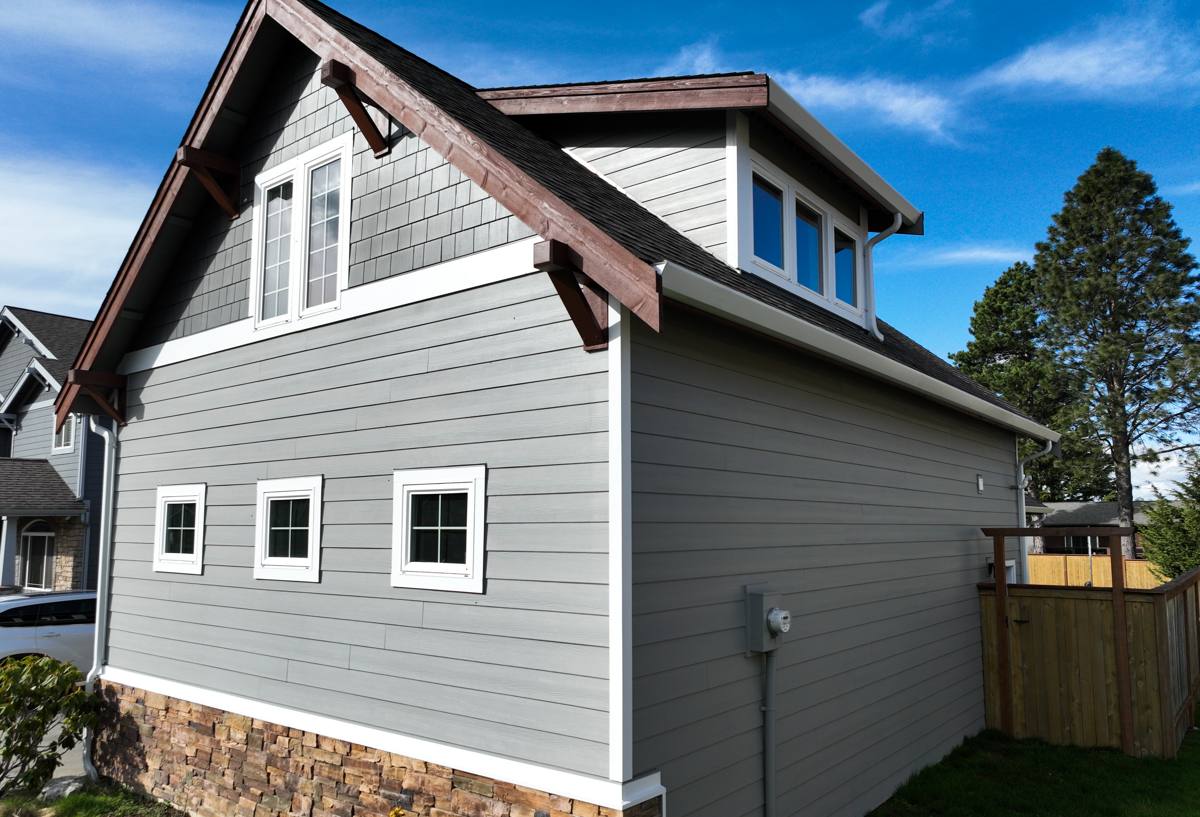
| HardieShingle Siding | Staggered or straight-edge shingle profile | Coastal or craftsman-style architecture |
| HardieTrim Boards | Fascia, corner boards, window/door trim | Finishing detail work on any Hardie project |
| HZ10 / HZ5 Formulations | Same profiles, engineered for climate zone | HZ10 is the formulation for Florida's humidity and moisture cycling |
ColorPlus factory-applied finish is worth calling out specifically. Instead of field-painting the siding after installation, the color is baked on at the factory under controlled conditions, which gives more even coverage, better fade resistance under Florida UV, and a longer runway before repainting is ever needed — a real advantage in a climate that's brutal on job-site paint jobs.
What a Correct Installation Involves
Fiber cement siding's real-world performance depends heavily on installation quality — this is true of any brand, and it's part of why we're selective about the crews doing the work on Parrish homes. Fastener placement, gapping at butt joints, flashing details around windows and penetrations, and starter strip work all affect whether water sheds correctly or finds a way behind the siding.
- Correct nail or screw placement per Hardie's fastening specifications, not generic siding practice
- Proper clearance gaps at butt joints to allow for expansion without buckling
- Weather-resistant barrier installed correctly underneath, not just siding over whatever's already there
- Flashing integrated at every window, door, and penetration — this is where most moisture failures actually start
- Caulking only where Hardie's install guide specifies it, not as a substitute for proper flashing
- Field-cut edges sealed to protect the factory finish from moisture wicking
Skipping any of these steps can void the manufacturer's warranty even when the material itself is correct — which is why installation quality is as much a part of the "why James Hardie" answer as the product itself.
Siding, Roofing, Windows, and Decks — the Whole Exterior Envelope
Siding doesn't work in isolation. It's part of a system with the roof, windows, and any attached structures like decks, and problems in one area often show up as damage in another. A roof leak can travel down behind siding for months before it's visible from the outside. Failing window flashing can rot the siding and trim around it. A deck ledger board attached without proper flashing can introduce moisture right at the house's exterior wall.
Because Bradenton Siding Co handles siding, roofing, windows, and decks, we look at a Parrish home's exterior as one connected system rather than four separate trades that don't talk to each other. That matters most when we're diagnosing a problem that isn't obviously "just siding" — and it matters again during a full exterior renovation, where coordinating the sequence of work (roof, windows, siding, decking) correctly saves homeowners from redoing flashing details twice.
Cost Factors for a Parrish Siding Project
Every home is different, but the same handful of factors drive most of the cost variation we see on siding projects in this area. We won't quote a number without seeing the house, but here's what typically moves the price up or down.
| Factor | Why It Matters |
|---|---|
| Home size and elevation count | More square footage and more architectural detail (gables, dormers) means more material and labor |
| Existing siding removal | Tear-off and disposal of old vinyl, wood, or damaged siding adds labor time |
| Substrate condition | Rotted sheathing found underneath old siding needs repair before new siding goes on |
| Product line and profile | Lap, panel, and shingle profiles have different material and install costs |
| Trim and finish work | Corner boards, window trim, and fascia detail add to scope |
| Access and site conditions | Multi-story sections, tight lots, or landscaping obstacles affect labor time |
Why a Local Manatee County Crew Matters
Hiring a contractor based in the area, rather than a traveling crew that's in and out of the county, matters for a few practical reasons. A local crew understands the specific building code and permitting process that applies in Manatee County, knows how local wind-load requirements factor into fastening and material specs, and is still around next year if a warranty question or minor issue comes up. We're not guessing at what Parrish homes go through — we see it, house after house, across the seasons.
It also means we can move on scheduling and follow-up faster than an out-of-town operation, which matters when storm season is approaching and homeowners are trying to get exterior work done before the summer weather pattern sets in.
Get a Straight Answer on Your Siding
If you're weighing a siding replacement, dealing with an aging exterior, or just want an honest read on what's going on with your home in Parrish, we're glad to take a look. We'll tell you what we actually see — no pressure, no inflated scope — and walk you through what James Hardie siding would look like for your specific house. Reach out below for a free estimate.